Program Management
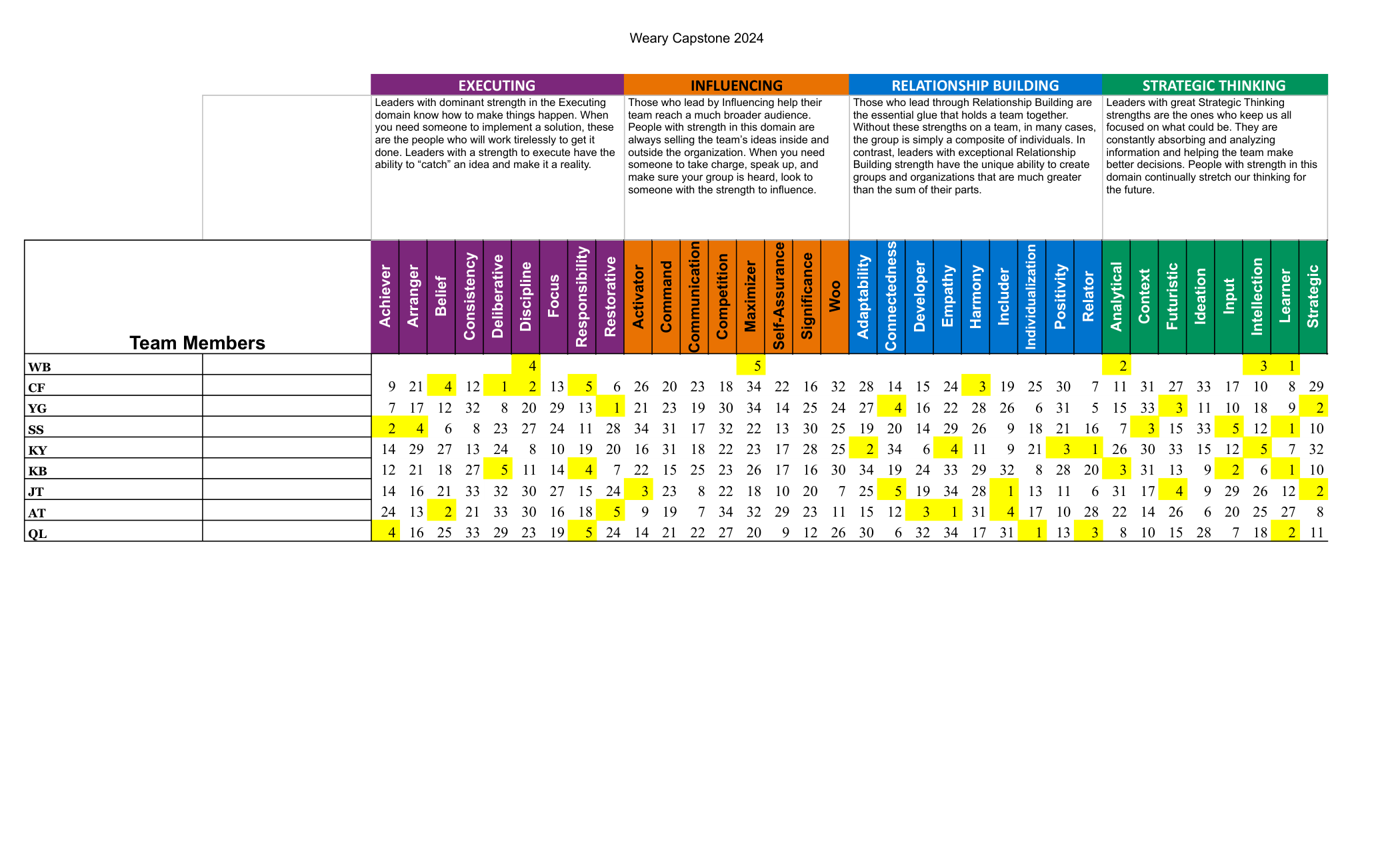
This strengths grid visualizes the distribution of CliftonStrengths themes across the Philanthropy Southwest Capstone 2024-2025 team, highlighting the collective balance of Executing, Influencing, Relationship Building, and Strategic Thinking talents. I used this analysis to support team coordination, delegate responsibilities based on strengths, and ensure balanced representation across domains during a multi-phase research and evaluation project.
Program management has been a constant thread throughout my graduate and professional work, often emerging in spaces where structure needed to be created rather than followed. Two experiences in particular—the Louisiana performance evaluation and my role as Project Co-Manager for the Philanthropy Southwest capstone—shaped my approach to organizing people, timelines, and complex deliverables.
In the Louisiana evaluation project, I helped coordinate more than thirty students working across multiple teams under the leadership of Dr. Frank Ashley III. I managed timelines, aligned moving parts, coordinated communication between subgroups, and served as a bridge between students and faculty. It was the first time I had managed an initiative of that scale, where the visibility was high and the stakes were real. The project required not just logistical oversight, but also the emotional labor of building trust through listening sessions with faculty, staff, and students—ensuring that the voices we heard were meaningfully reflected in the final report.
A year later, in my Philanthropy Southwest capstone, I served as Project Co-Manager, overseeing my sub-team’s workflow while collaborating closely with the manager of the second team to align timelines, ensure cohesion, and maintain communication across both workstreams. Together, we coordinated interviews, scheduled client check-ins, analyzed data, and produced a comprehensive funder’s guide. Working across teams taught me how to balance autonomy and alignment—knowing when to step forward to provide structure, and when to step back to allow others to lead.
These experiences were reinforced by the practical program management I carried out in my development work for Texas A&M’s newest college. I maintained a grant calendar, coordinated donor outreach, led a corporate in-kind campaign independently, and managed a holiday mailout of more than 100 donor gifts. Each effort required clear planning, attention to detail, and steady communication across stakeholders with different needs and priorities.
Across all of these roles, I’ve learned that effective program management is equal parts structure and flexibility. It means developing systems that support people, not replace them. It requires empathy, communication, and the willingness to adapt as new information emerges. Above all, it means keeping sight of the purpose behind the work—whether that purpose is supporting a school, guiding a philanthropic organization, or strengthening a new academic unit.
“Plans are nothing; planning is everything.” — Dwight D. Eisenhower